Pillar Guide · Roof Leak Repair
Roof Leak Repair in Beaumont
A leaking roof is a tracing problem before it is a repair problem. The stain on your ceiling marks where the water finished its journey, not where it started.
This guide explains where Beaumont roof leaks actually come from, how a contractor finds the true entry point, what the repair involves, and what drives the cost, so you know what to expect before you call.
The Problem
Why do roofs leak, and why does the source hide?
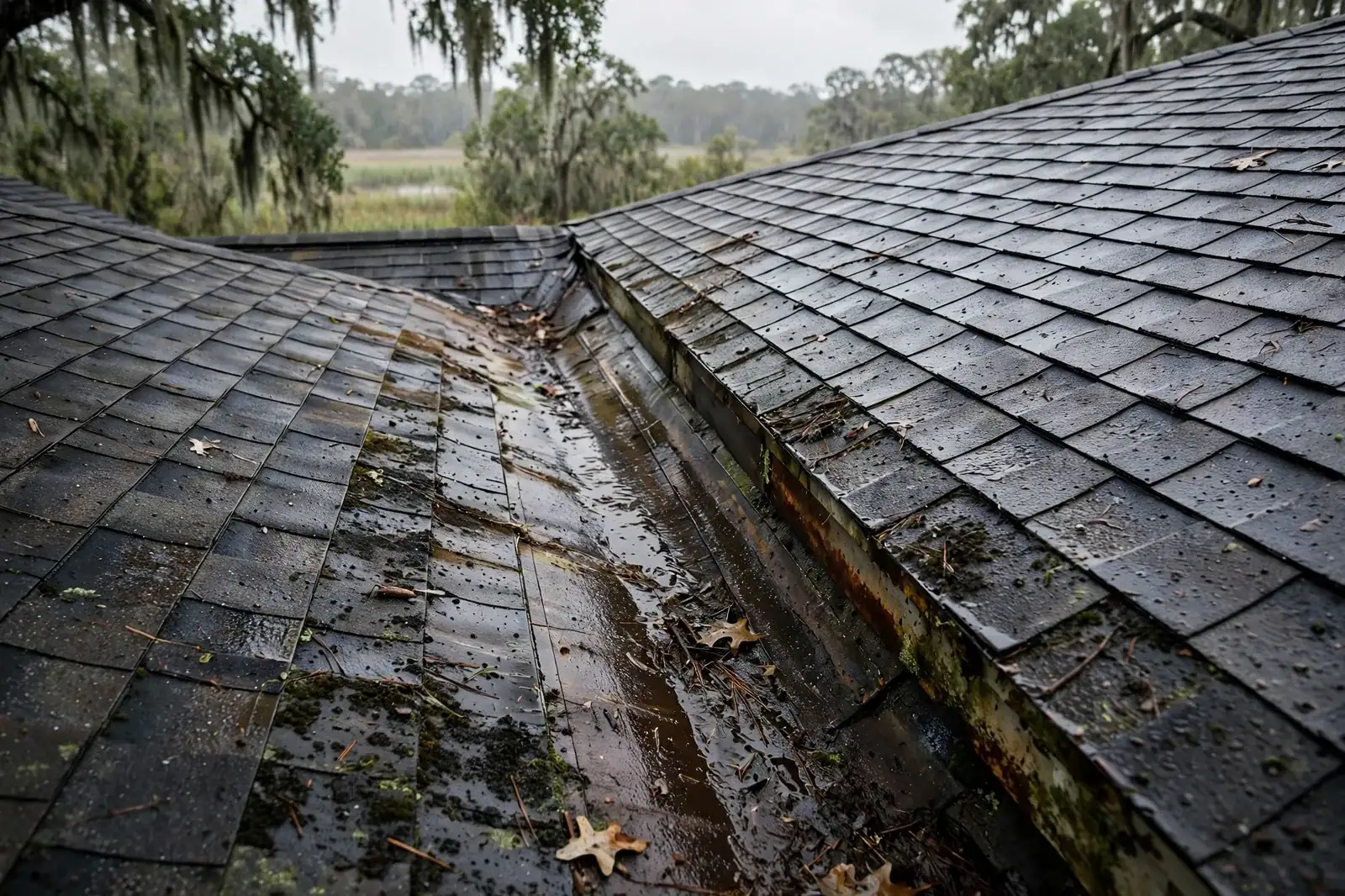
A roof leak starts small. A rubber boot splits around a vent pipe, a strip of flashing lifts at a chimney, a shingle cracks in the heat. Water enters at that point, often only when rain is heavy or driven by wind, and then it travels. It runs along the decking, follows the slope and the framing, and appears inside the house wherever gravity finally pulls it through, which can be several feet from the entry point.
Beaumont makes this worse than most places. The city takes some of the heaviest rainfall in Texas, and Gulf storms drive rain sideways and upward under shingle edges that would hold in a gentle rain. A weakness that stays dry for months can leak hard in one tropical downpour. Heat does the slow work the rest of the year: sealants dry out, rubber cracks, and asphalt shingles lose the flexibility that keeps them sealed flat.
The result is that the visible problem inside the house and the actual problem on the roof are two different things. Treating the stain, or sealing the area directly above it without checking, is how leaks get “fixed” three times and still come back. The sections below set out the real causes, in the order a contractor checks them.
Causes
What causes a roof leak in Beaumont?
Nearly every leak traced in Beaumont comes back to one of these seven failures. Each one has a distinct repair, which is why finding the right cause matters more than finding the stain.
Cracked pipe boots
The rubber boot that seals each vent pipe dries out and splits in the Gulf Coast heat. It is the single most common leak source on Beaumont homes, and it usually fails years before the shingles around it do.
Worn and lifted flashing
Flashing is the metal that seals the joints where the roof meets a wall, a chimney or a valley. When it rusts, lifts or loses its seal, wind driven rain gets underneath and travels into the roof deck.
Damaged shingles
Missing, cracked or curled shingles expose the underlayment and the nail heads below it. One storm can open a small gap that only leaks in heavy rain, which is why the stain often appears long after the damage.
Valley and seam failures
Valleys carry more water than any other part of the roof. Worn valley metal, failed sealant and debris sitting in the valley all push water sideways under the shingle edges instead of down and off the roof.
Skylight seals
Skylights leak at the seal between the unit and the roof, and at the flashing kit around it. The drip shows on the ceiling below, but the failure is almost always at the edge of the skylight, not the glass.
Storm lifted edges
High wind lifts shingle edges and breaks the sealant bond that keeps them flat. The shingles may settle back and look fine from the ground while the seal underneath is gone, ready to let the next downpour in.
Failed sealant and exposed fasteners
Sealant around penetrations and the fasteners that hold flashing and vents are consumables: they dry out, crack and shrink with age and heat. Once a sealant line fails, every penetration it protected becomes an entry point, and exposed nail heads rust through and let water follow the shank straight into the deck.
The Process
How is a leak traced and repaired?
Trace the source
The contractor starts from the stain inside, measures its position against the roof above, then inspects that area and everything uphill of it: boots, flashing, valleys, vents and shingle condition.
Repair and reseal
The failed part is removed and replaced, not covered over. New material is integrated with the shingles around it so water sheds over the repair instead of behind it.
Check the surroundings
The area around the repair is checked for the next failure forming: ageing boots, lifted edges, worn sealant. Anything found is reported to you before it becomes the next leak.
If the inspection finds water damage under the surface, such as soft or stained decking, that section is replaced as part of the repair. Sealing new material over rotten decking does not hold, and a proper repair does not do it. The contractor explains anything of this kind, and its effect on the price, before the work goes ahead.
Confirming the Source
How is the true entry point confirmed?
It is confirmed by testing, not by guessing from the stain. The contractor first measures the stain’s position inside the house against the roof above it, then checks the attic side where access allows: stained or soft decking, wet insulation and daylight at a penetration all point back toward the entry. From there the likely candidates, the boots, flashing lines, valleys and vents uphill of the stain, are examined one by one for the failures listed above.
Where the source still is not certain, a controlled water test settles it. Water is applied to one small section of roof at a time, starting low and working uphill, while the attic or ceiling below is watched. The section that produces the drip is the entry point. Testing in sections matters: flooding the whole slope at once only proves the roof leaks somewhere, which you already knew.
Confirmation is what separates a repair from a repeat call. A sealed guess can hold through light rain and fail in the next downpour, because the real opening was a foot away the whole time. A tested source lets the contractor repair the actual failure, check the material around it, and stand behind the result. When you call, describing exactly where the water shows and when it appears, dry weather or only in heavy rain, gives this process a head start.
Cost Factors
How much does a leak repair cost in Beaumont?
Leak repairs in Beaumont commonly fall between $300 and $900, and four things move a job inside that range. The first is the source itself: a pipe boot is a small, quick replacement, while a failed valley means lifting and relaying a whole section of roof. The second is access. A leak above a steep pitch or a two storey section takes more time and more safety setup than one over a low, simple slope.
The third factor is what the water has done on its way in. A leak caught early may need nothing beyond the failed part. A leak that has been running for a season can mean decking replacement and ceiling damage, and the roofing part of that job grows accordingly. The fourth is material: tile and metal roofs need matching parts and more care around the repair than standard asphalt shingle work.
The four factors combine rather than simply add. A cheap part in an awkward place, a cracked boot above a steep two storey slope, can cost more than a mid range part over a low porch roof, because access drives the labour. And a modest repair caught late can outgrow a bigger repair caught early, because hidden decking damage adds material and time to any job. This is why phone quotes for leaks are unreliable: until the source is confirmed and the decking under it is checked, nobody knows which end of the range your job sits at, and any number given before inspection is a guess dressed as a price.
The full breakdown, with ranges by repair type, is in the Beaumont roof repair cost guide. Every price is confirmed by the contractor after inspection and before work begins.
When To Call
How long can you safely wait on a leak?
Only as long as it takes to make the call. A leak does not stay the size it started. Every rain pushes more water through the same opening, and the decking, insulation and ceiling below it deteriorate a little more each time. A stain that grows, paint that bubbles, or a musty smell in one room are all signs the leak is active and has been running longer than the stain suggests.
If water is coming through now, go to the emergency roof repair page for what to do in the first hour. If the leak is slow or only appears in heavy rain, call and describe it: the contractor will advise whether it needs immediate tarping or can be booked as a standard repair.
Go deeper
City Page
Emergency Roof Repair in Beaumont
Water coming in now is a different job from a slow leak. The city page covers emergency call-outs, tarping and storm response across Beaumont.
Open the city page →Neighbourhood Page
Roof Repair in West End
Leaks behave differently on older roofs. The West End page covers the housing stock, roof types and common leak points in that neighbourhood.
Open the West End page →Cost Guide
Roof Repair Cost in Beaumont
Ranges by repair type, what drives the price up or down, and how to judge a repair against a replacement.
Open the cost guide →Roof Leak Repair by neighbourhood
The Roof Leak Repair in Beaumont, TX city page covers the whole city. Each neighbourhood page below looks at roof leak repair on its own streets, with its own housing and exposure.
FAQ
Roof leak repair questions
Water rarely falls straight down from the entry point. It runs along the underside of the decking, follows a rafter or a seam, and drips off at the lowest point it reaches, which can be a full room away from where it got in.
That is why a proper leak repair starts with tracing, not with the stain. The contractor works back from the stain, checks the roof directly above and uphill of it, and tests the likely entry points until the real source is found.
Most leaks are local problems: one boot, one section of flashing, one damaged valley. When the rest of the roof is sound, repairing the failed part is the right fix and a new roof is not needed.
Replacement enters the conversation when the shingles themselves are at the end of their life across the whole roof, or when leaks keep appearing in new places because the material has aged out everywhere at once. The contractor who inspects your roof will tell you which situation you are in.
A single source repair, such as a pipe boot or a small flashing section, is often completed in one visit once the roof is dry enough to work on. A leak that has damaged decking or spread under a valley takes longer, because the damaged material has to come out before the new material goes in.
Weather sets the schedule as much as the repair does. Sealants and shingles need a dry surface to bond, so a repair booked during a wet week in Beaumont may be made watertight first and finished when the rain clears.
A repair that fixes the true entry point and the material around it should hold for the remaining life of that part of the roof. Leaks come back when the repair treated the stain instead of the source, or when a second entry point nearby was missed.
This is why the process on this page includes checking the area around the leak, not just the leak itself. If the inspection finds a second weak point forming, the contractor will point it out so you can decide whether to deal with it at the same time.
Get your leak traced and repaired
One call connects you with a Beaumont contractor who handles leak repair. Describe where the water is showing and when it started.