Pillar Guide · Roof Flashing Repair
Roof Flashing Repair in Beaumont
Flashing is the metal work that waterproofs every joint on a roof, and it is behind more leaks than any damaged surface. This guide explains where flashing fails in Beaumont, why sealant alone does not fix it, and how proper flashing repair is done.
The Problem
Why does flashing cause so many Beaumont roof leaks?
Every roof is interrupted, by chimneys, walls, vents, valleys, and changes of pitch, and at every interruption the roofing material alone cannot keep water out. Flashing, shaped metal fitted in layers with the roofing, bridges those joints and directs water back onto the surface. It is detailed, hand made work, and it lives in the harshest conditions on the roof, constant water flow, thermal movement between different materials, and in Beaumont, humid air that corrodes metal and bakes sealants hard. When flashing fails, water enters at the joint and can travel widely from there.
The leaks flashing produces are misleading by nature. Water entering at a chimney flashing may run down inside the wall and stain a ceiling a room away. A failed wall flashing can soak the top of a wall for months before paint blisters give it away. Homeowners reasonably suspect the shingles or the chimney itself, and repairs aimed at those innocent parties leave the joint open. Contractors in Beaumont treat any leak near a junction as a flashing case until proven otherwise, because experience here says that is where the odds lie.
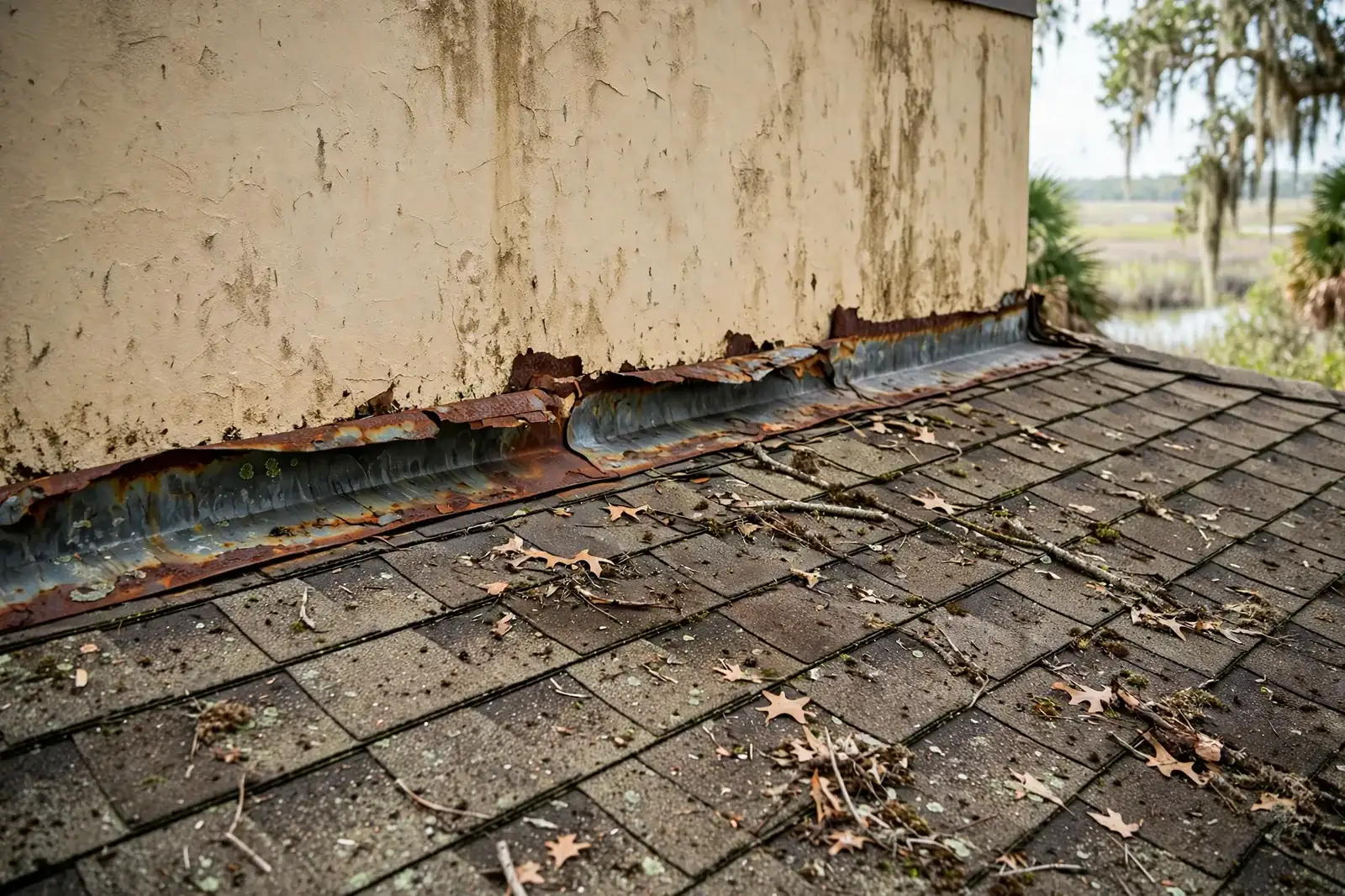
Flashing also fails quietly in its materials. Galvanised metal corrodes through at bends and nail holes, aluminium can be attacked by mortar contact at chimneys, and the sealants used to finish flashing details harden and part long before the metal itself is spent. A roof can therefore need flashing work at several joints in the same period even though its main surface has years left. That pattern, leaks at junctions on a sound roof, is a flashing programme asking to be recognised, not a roof asking to be replaced.
Causes
What makes roof flashing fail in Beaumont?
Flashing fails through corrosion, movement, poor original fitting, and aged seals, all accelerated by Gulf conditions. These are the specific failures behind most flashing repairs.
Corrosion at bends and fixings
Flashing metal is folded to shape, and the folds, cut edges, and nail holes are where its protective coating is thinnest. Humid Beaumont air works at those points until pinholes and split lines open, often hidden under the roofing overlap. Corroded flashing can look acceptable on its visible face while its buried sections have failed, which is why assessment means easing material back, not just looking.
Sealant breakdown at joints
Many flashing details depend on a sealant bead to finish the joint, and that bead has the shortest life of anything on the roof. Gulf heat hardens it, movement cracks it, and once it parts, the joint it finished is open to driven rain. Sealant failure alone is a maintenance item, but resealing over corroded or badly shaped metal underneath is the classic wasted flashing repair.
Thermal movement and loose fixings
Metal expands and contracts daily, and the structures it is fixed to move at different rates. Over years this works fixings loose, opens laps between flashing pieces, and fatigues the metal at its bends. Step flashing pieces can migrate out of position one small movement at a time. The joint still looks flashed from the ground while its overlaps have quietly become too short to work.
Incorrect original installation
Flashing fitted in the wrong order, pieces lapped so they channel water behind instead of over, counter flashing surface mounted instead of cut into a wall, will leak from its first serious storm and at every one after. Beaumont contractors meet these legacy errors regularly on older homes and on rushed work. No amount of sealant corrects a backwards lap, the detail has to be rebuilt in the right sequence.
Storm lifting and debris damage
Wind gets under exposed flashing edges at ridges, verges, and chimney saddles, bending metal back and breaking its seals, and falling debris dents and tears flashing in valleys where water concentrates. Storm damaged flashing may sit back nearly in place, hiding a crease crack at the bend. After severe weather, flashing lines belong on the inspection list alongside shingles and caps.
Mortar and masonry joint failure
Where counter flashing is chased into a chimney or wall joint, the mortar holding it deteriorates, and where flashing meets masonry, the pointing around it cracks and admits water behind the metal. The flashing itself may be sound while its anchorage has failed. These cases need the joint remade, sometimes with masonry work sequenced before the roofer finishes the detail.
The Process
How is flashing repaired properly?
Expose and inspect the joint
The roofing around the failed joint is eased or lifted so the flashing can be seen in full, including its buried laps and fixings. The contractor checks for corrosion, lap order, seal condition, and movement, and photographs the findings. This exposure step is what separates a flashing repair from a flashing guess, and it should be part of any quote for joint leaks.
Remove failed metal and seals
Corroded or wrongly fitted flashing is taken out, old sealant is cleaned away, and the surfaces it protects, decking, wall, masonry, are checked for water damage and made good. Timber or sheathing softened by the leak is replaced at this stage. New metal over damaged substrate simply hides a problem the joint created and the joint will be blamed for again.
Fit new flashing in correct layers
New flashing is cut, folded, and fitted in the correct overlapping sequence with the roofing and wall materials, fixed so movement is accommodated, and counter flashed into the wall or chimney joint where the detail requires it. Each piece is set to shed water over the next, tested by eye along the water path from top to bottom of the joint.
Seal, refit surface and test
The roofing surface is relaid over the new flashing, seals are finished where the detail calls for them, and the joint is water tested where practical. You are shown the completed detail and told which other joints on the roof are at a similar stage, because flashing ages as a set and the next joint is usually predictable.
In Detail
Why is sealant alone never a flashing repair?
Sealant fails as a flashing repair for a simple reason, it is asked to do the metals job. A bead smeared over a joint has to stretch across a moving gap, in full Gulf sun, while water flows over it in every storm, and no bead survives that assignment for long. Worse, surface sealant can dam water that would otherwise drain, holding it against the very laps it is meant to protect. Beaumont roofs are full of thick, cracked sealant monuments over flashing that needed one properly folded piece of metal, and removing them is now part of the real repair.
That is not a case against sealant itself, which has a correct role finishing specified joints, sealing fixings, and dressing terminations as part of a metal detail. The difference is order and honesty, metal first, shaped and lapped to shed water by geometry, sealant second, as the finisher. When a contractor quotes flashing work, the description should name metal removal and refitting. If the quote is only for sealing, you are being sold the short version, and in this climate its lifespan is measured in months, not years.
Local Conditions
How does Beaumont weather drive roof flashing repair?
For roof flashing repair, Beaumont's climate is not background detail, it is the cause behind most calls. ['Lamar University', 'Neches River, along the east side of the city', 'Interstate 10, crossing Beaumont east to west', 'Dowlen Road retail corridor, including Parkdale Mall', 'Spindletop, site of the 1901 oil gusher, marked by the Spindletop Gladys City Boomtown Museum', 'McFaddin Ward House Museum on the Calder Avenue corridor', 'Texas Energy Museum in downtown Beaumont', 'Tyrrell Park and the Beaumont Botanical Gardens and Cattail Marsh area in the southwest of the city'] Beaumont has a humid subtropical climate in the Piney Woods region of eastern Texas and is among the wettest parts of the state, with annual rainfall around 60 inches in published climate summaries.
Hurricanes and tropical storms are a recurring fact of life on this part of the Gulf Coast. Tropical Storm Imelda in 2019 also caused historic flooding in the city. A contractor who works in Beaumont reads that weather history in the roof itself, which is why local experience matters for roof flashing repair.
Much of the city's roof stock is therefore 40 to 100 years old in structure, even where the roof covering itself has been replaced several times. For roofs, the Beaumont combination that matters is high annual rainfall, sustained humidity, algae friendly shade, and periodic hurricane wind and wind driven rain. None of that makes roof flashing repair unusual work in Beaumont. It makes it routine work, done by contractors who see the same Gulf weather patterns on roofs across the city every week.
Cost Factors
What does roof flashing repair cost in Beaumont?
Flashing pricing depends on the joint involved, access, and how much surrounding material must be lifted. These rows cover the typical Beaumont flashing work.
Ranges are general guidance, not a quote. The contractor confirms the final price after inspecting your roof.
When To Call
When should flashing be checked on a Beaumont roof?
Check flashing when a leak appears near any chimney, wall junction, valley, or vent, when you see rust streaks, lifted metal edges, or cracked sealant at a joint, or when mortar around chimney flashing crumbles. Flashing leaks in humid Beaumont conditions damage wall timber and decking out of proportion to the visible stain, because the entry sits inside the construction. Early joint work is among the best value repairs on the whole roof.
Flashing also deserves a place in any pre storm season inspection, since its failures are exactly what driven rain exploits. A joint that sheds a calm shower can pass a storm straight into the wall. Contractors can grade each joint for you, sound, watch, or repair, and that short list, dealt with in calm weather, prevents the most common category of leak in the city.
Go Deeper
Where does roof flashing repair go from here?
City Page
Roof Flashing Repair in Beaumont, TX
The local service page for roof flashing repair across Beaumont, with first steps, response and coverage.
Open the city page →Neighbourhood
Roof Flashing Repair in Calder Place
How roof flashing repair plays out in Calder Place, with the problems local homes see most.
Roof Flashing Repair in Calder Place →Cost Guide
Roof Repair Cost
Typical Beaumont price ranges for this kind of repair and what moves the price.
Read the cost guide →Roof Flashing Repair by neighbourhood
The Roof Flashing Repair in Beaumont, TX city page covers the whole city. Each neighbourhood page below looks at roof flashing repair on its own streets, with its own housing and exposure.
FAQ
Roof Flashing Repair questions, answered
Location is the first clue, stains below or beside a chimney, wall junction, or valley point to flashing, while stains mid slope with damaged units above them point to the surface. Timing helps too, flashing leaks often worsen sharply in wind driven rain that attacks the joint.
Certainty needs the joint exposed and inspected, which is why a contractor visit is worthwhile rather than repeated surface patching. Misdiagnosed joint leaks are the most re repaired leaks in Beaumont for exactly this reason.
Minor seal renewal at an accessible, sound metal detail can sometimes be done from the surface. Genuine flashing repair, replacing corroded or badly lapped metal, requires lifting the surrounding roofing to reach the buried sections and to refit the layers in order.
Be cautious of any flashing quote that promises full renewal with no lifting at all. The metal that matters most is the part you cannot see, and a repair that never reaches it has not reached the failure.
The right choice depends on the joint and the metals already present, galvanised steel and aluminium are both common locally, and compatibility with neighbouring materials matters, since some metals corrode each other in damp contact, and mortar contact rules out some options at chimneys.
Your contractor should name the material in the quote and the reason for it. In Beaumont humidity, that compatibility question is practical, not fussy, a mismatched flashing can corrode faster than the failed original it replaced.
Often, yes, in time. Flashing across a roof was usually fitted in the same week with the same materials and has lived the same weather, so joints reach their limits in loose sequence. A repair visit should grade the remaining joints so you can plan rather than be surprised.
That said, exposure differs, a sheltered wall joint may outlast a storm beaten chimney flashing by years. The grading, not a blanket renewal, is the right response, joint by joint evidence over general alarm.
Talk to someone about your roof today
Describe the problem on one call and get connected with a local Beaumont roofing contractor.