Pillar Guide · Flat Roof Repair
Flat Roof Repair in Beaumont
Flat and low slope roofs do not shed water, they manage it, and in Beaumont rainfall that difference decides everything. This guide explains ponding, seams, and membrane failures, and how flat roof repairs restore drainage and a watertight surface.
The Problem
Why do flat roofs struggle so much in Beaumont rain?
A pitched roof forgives small flaws because gravity clears water in seconds. A flat or very low slope roof holds every flaw accountable, because water moves slowly, stands in any shallow hollow, and has time to find seams, pinholes, and laps. Beaumont delivers rain in volumes and at frequencies that turn a minor ponding area into a permanent shallow pool, and a pool is a leak searching for an entry with unlimited patience. Most flat roof failures here are drainage failures first and material failures second.
The membrane itself works hard in this climate. Heat expands it, ponded water and algae work on its surface, and every penetration, vent, drain, and edge, is a hand made detail that can open. Older Beaumont homes with flat sections over porches, additions, and garages often carry membranes that were patched repeatedly with incompatible products, each layer trapping moisture under the next. The result is a roof that leaks in several places with no single obvious cause, until a contractor maps the water and the layers together.
Flat sections also hide their damage. A membrane can look intact while the insulation and decking beneath it are saturated from a seam that opened months ago, spreading damp sideways far beyond the entry. The first indoor sign may be a stain at a wall that has nothing above it but sound looking membrane. Proper flat roof repair therefore starts with moisture investigation, not just surface inspection, and the honest scope sometimes includes what is under the membrane as well as the membrane itself.
Causes
What causes flat roof leaks and failures in Beaumont?
Flat roof problems in this climate trace to water standing where it should move, and to details opening under heat and age. These are the failures contractors check first.
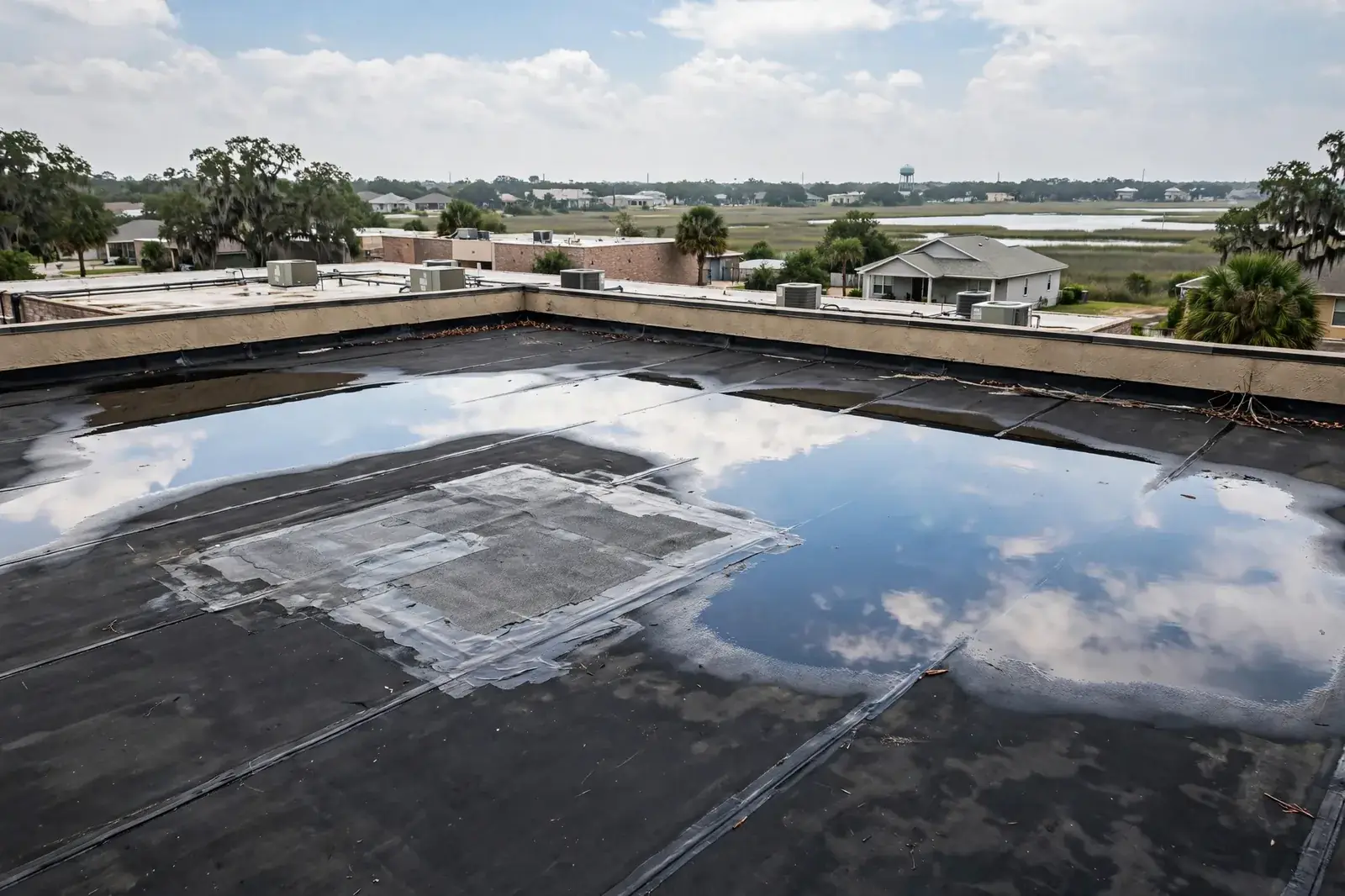
Ponding water in low spots
Deck deflection, settled insulation, and poorly planned falls create hollows where rain stands long after the storm. Standing water adds weight, which deepens the hollow, and works continuously on seams and surface defects inside the pond outline. The dark tide mark of a regular pond is one of the most useful diagnostic sights on a Beaumont flat roof.
Open seams and laps
Membrane sheets are joined by seams that depend on their original bonding, welding, or adhesive, and heat cycling and age work those joints until an edge lifts. Once a seam lip opens, slow moving water enters directly and travels between layers. Seam failure is the leading membrane leak cause locally, and probing every seam is basic flat roof inspection work.
Failed details at penetrations and edges
Vents, drains, pipes, and perimeter edges interrupt the membrane and rely on fitted flashing and seal details that age faster than the field. Cracks and lifting at these points admit water at exactly the places it collects. On many Beaumont flat sections the field is sound and every leak maps to a detail, which is good news for the repair scope.
Blistering and surface breakdown
Moisture trapped under or within the membrane expands in Gulf heat and raises blisters, while ultraviolet exposure and ponded algae degrade the surface itself. Broken blisters and eroded areas become pinholes, and each pinhole feeds more moisture under the surface. Surface breakdown across a whole flat section usually means the membrane system, not one detail, is at end of life.
Blocked or failed drains
Flat roofs drain through internal outlets or scuppers that clog with leaves, granules, and storm debris quickly in Beaumont. A blocked drain can pond a whole section deeply in one downpour, overloading seams and edge details never designed for a pool. Drain function is therefore part of the roof, and clearing and testing drains belongs in every flat repair visit.
Incompatible patch layers
Different membrane and coating products often do not bond to each other, and patches applied over the wrong surface peel at the edges and trap water underneath. Homes with a history of quick patching frequently have several such layers over one original failure. The durable repair strips the incompatible work back to a surface the new material can actually join, then rebuilds the detail.
The Process
How is a flat roof repaired properly?
Map ponds, seams and moisture
The contractor surveys the section after rain or by its tide marks, probes seams and details, and checks for saturated material beneath the surface by core inspection or moisture testing where the signs point that way. This map decides whether the job is detail work, section renewal, or drainage correction, and it prevents sealing a dry looking skin over a wet roof.
Correct the drainage first
Blocked drains and scuppers are cleared and tested, and where a pond comes from a genuine low spot, the repair plan includes building the fall back up with tapered material as the section is rebuilt. Skipping drainage correction dooms surface repairs, because the same pool will sit on the new work and test it permanently.
Strip and rebuild failed areas
Failed membrane, open seams, and saturated underlayers are cut out to sound material. New membrane is fitted with seams made and finished to the system specification, and details at penetrations and edges are renewed as part of the same operation. Compatibility of every product used with the existing system is confirmed before it goes down.
Flood check and finish
Where practical, the repaired section is checked by controlled water or at the next rain, watching the interior below and the drainage behaviour above. Edges and seams receive a final inspection pass. You receive a record of pond areas and detail condition, because on a flat roof that maintenance map is the basis of every future decision.
In Detail
What should you know about ponding and membrane life?
A useful working rule is that water standing a day or two after rain in dry weather is telling you the fall or the drain is failing, whatever the membrane looks like. In Beaumont, where rain returns quickly, a marginal pond can be effectively permanent through the wet months, and seams inside it live submerged. Treating drainage as part of the repair, rather than an optional extra, is the single decision that separates flat roofs that settle down from flat roofs that leak on a schedule, regardless of how new their surface is.
Membrane life here is also shortened by what collects on it. Leaves and debris hold damp against the surface, algae darkens and degrades ponded areas, and foot traffic to rooftop equipment crushes insulation and creates new hollows. A flat section that is kept clear, walked carefully, and checked at its seams and drains each year asks far less of its owner than one visited only when the ceiling below complains. Flat roofs reward routine attention more than any other type in this climate.
Local Conditions
How does Beaumont weather drive flat roof repair?
For flat roof repair, Beaumont's climate is not background detail, it is the cause behind most calls. Beaumont housing spans oil boom era historic homes from the early 1900s in and around the Oaks Historic District, mid century ranch and bungalow housing across South Park, Pear Orchard and the North End, and late twentieth century tract subdivisions on the west side in areas such as Dowlen West, Amelia and Calder Highlands. ['Lamar University', 'Neches River, along the east side of the city', 'Interstate 10, crossing Beaumont east to west', 'Dowlen Road retail corridor, including Parkdale Mall', 'Spindletop, site of the 1901 oil gusher, marked by the Spindletop Gladys City Boomtown Museum', 'McFaddin Ward House Museum on the Calder Avenue corridor', 'Texas Energy Museum in downtown Beaumont', 'Tyrrell Park and the Beaumont Botanical Gardens and Cattail Marsh area in the southwest of the city']
Beaumont has a humid subtropical climate in the Piney Woods region of eastern Texas and is among the wettest parts of the state, with annual rainfall around 60 inches in published climate summaries. Hurricanes and tropical storms are a recurring fact of life on this part of the Gulf Coast. A contractor who works in Beaumont reads that weather history in the roof itself, which is why local experience matters for flat roof repair.
Tropical Storm Imelda in 2019 also caused historic flooding in the city. Much of the city's roof stock is therefore 40 to 100 years old in structure, even where the roof covering itself has been replaced several times. None of that makes flat roof repair unusual work in Beaumont. It makes it routine work, done by contractors who see the same Gulf weather patterns on roofs across the city every week.
Cost Factors
What does flat roof repair cost in Beaumont?
Flat roof pricing depends on the system fitted, the ponding involved, and whether material under the membrane is wet. These rows cover the typical Beaumont flat repair work.
Ranges are general guidance, not a quote. The contractor confirms the final price after inspecting your roof.
When To Call
When does a flat roof need attention in Beaumont?
Call when you see water standing well after rain, seams lifting, blisters forming, or any indoor staining below a flat section, however small. Flat roof leaks spread sideways under the membrane, so the damp area below grows in the dark while the visible stain barely changes. Early work on a seam or a drain is minor, replacing saturated insulation and decking across a section is not, and the difference is mostly timing.
A pre storm season check is particularly valuable on flat sections in Beaumont. Clearing drains, probing seams, and confirming details before the heaviest rain of the year prevents the classic local failure, a blocked drain ponding a whole addition roof during a tropical downpour. If your flat section has not been looked at in several years, the check is overdue regardless of whether it has leaked yet.
Go Deeper
Where does flat roof repair go from here?
City Page
Flat Roof Repair in Beaumont, TX
The local service page for flat roof repair across Beaumont, with first steps, response and coverage.
Open the city page →Neighbourhood
Flat Roof Repair in Calder Highlands
How flat roof repair plays out in Calder Highlands, with the problems local homes see most.
Flat Roof Repair in Calder Highlands →Cost Guide
Flat Roof Repair Cost
Typical Beaumont price ranges for this kind of repair and what moves the price.
Read the cost guide →Flat Roof Repair by neighbourhood
The Flat Roof Repair in Beaumont, TX city page covers the whole city. Each neighbourhood page below looks at flat roof repair on its own streets, with its own housing and exposure.
FAQ
Flat Roof Repair questions, answered
A leak at a seam or detail on an otherwise sound, dry membrane patches well with compatible material correctly fitted. Patching is the right scope for a large share of Beaumont flat roof calls, especially detail leaks.
Renewal enters the discussion when the surface is breaking down generally, or moisture is found spread beneath the membrane. Patching over saturation only seals the damp in, and an honest contractor will show you the moisture evidence before recommending the larger scope.
Water entering a flat roof travels between layers and along the deck before it finds a way down, often emerging at a wall joint or light fitting far from the entry. The stain marks the exit, not the entry, which is why flat leak tracing works from the pond and seam map downward.
This travel is also why flat leaks damage more than they show. Saturated material can spread across much of a section from one open seam, and the inspection needs to establish that extent, not just locate the drip.
A well functioning flat section clears its water steadily and is essentially dry within a day or so of dry weather, allowing for shallow damp patches. A defined pool still present after that, with a visible tide line from repetition, indicates a fall or drainage problem worth correcting.
In Beaumont wet spells, judge by the dry intervals. If the same pond never disappears between rain events across weeks, it is functioning as a permanent pool on your seams, whatever the original design intended.
A coating over a sound, dry, correctly prepared membrane can extend surface life. A coating over failed seams, saturated underlayers, or an incompatible existing surface hides the problems and typically fails at the same points, having cost the money that could have rebuilt them.
The sequence matters, repair the system first, seams, details, drainage, moisture, then discuss surface protection. Any proposal that starts and ends with coating a leaking flat roof should be questioned closely.
Talk to someone about your roof today
Describe the problem on one call and get connected with a local Beaumont roofing contractor.